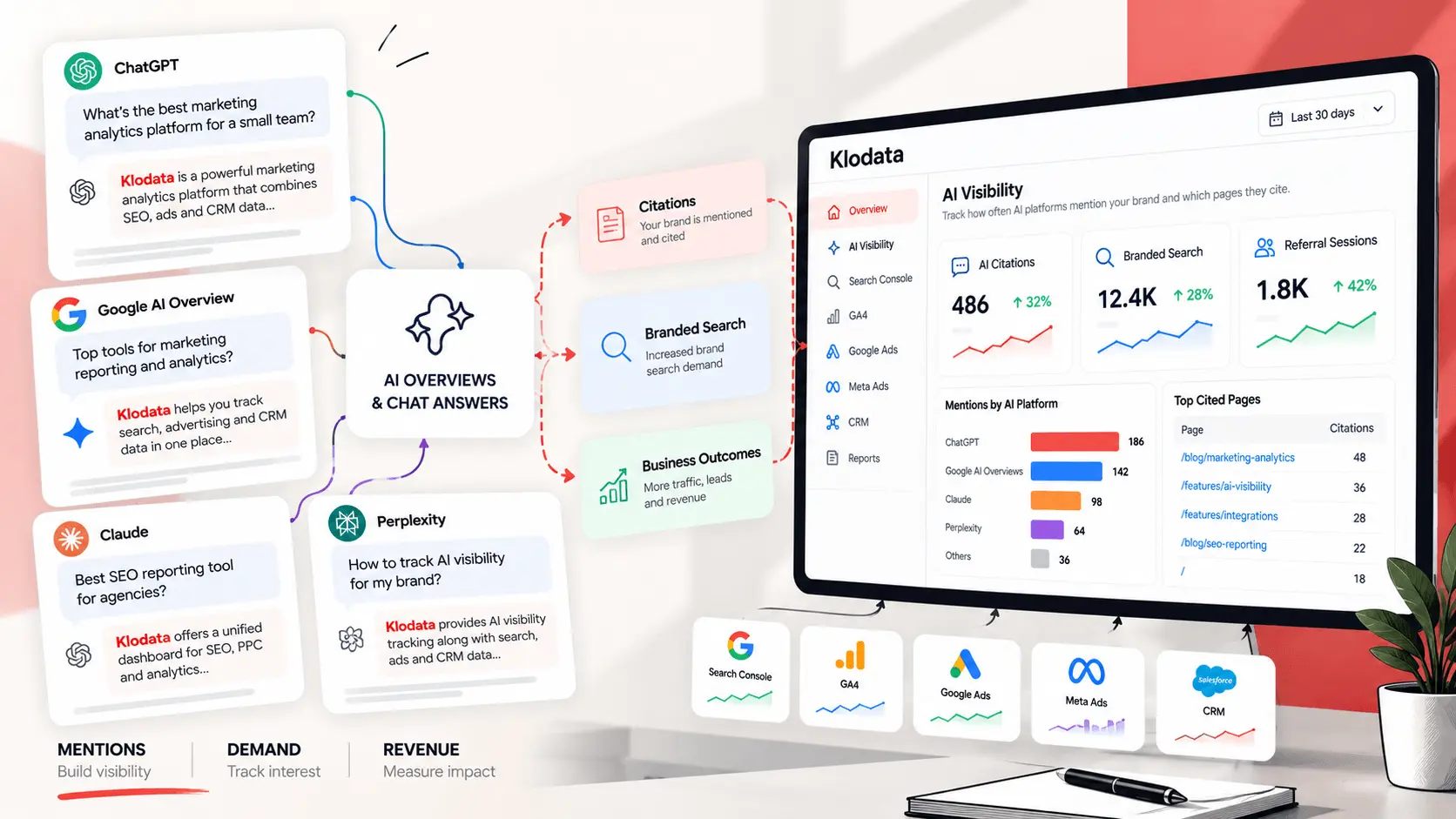
How to Measure AI Visibility Without Guesswork
Every time an AI answer mentions your brand, it creates a potential customer touchpoint that traditional analytics may never capture. Google Search Console tracks clicks and impressions, while AI chat interfaces often provide little or no referral information. As a result, it can be difficult to know whether your brand is actually appearing in AI-generated answers—or whether a dashboard is presenting an impressive-looking number without meaningful evidence behind it.
Measuring AI visibility requires a more practical approach. Instead of relying on a single score, combine three signals: AI citations, branded search demand, and downstream business outcomes. Together, they help you understand whether AI platforms mention your brand, whether that exposure generates interest, and whether that interest contributes to revenue.
1. Treat Prompts as Your New Keyword Set
Traditional SEO starts with keywords: the phrases people type into search engines. AI search introduces a different kind of query. People ask complete questions, provide context, and describe their needs in natural language.
For example, a buyer might search for "marketing analytics software" in Google. In an AI interface, the same person might ask, "What's the best marketing analytics platform for a small team that needs to combine SEO, advertising, and CRM data?"
Both queries express a related intent, but the second gives the AI more context about the buyer's needs.
This is why measuring AI visibility starts with building a useful prompt set.
Begin with the questions your sales and support teams hear repeatedly. Review customer conversations, product comparisons, frequently asked questions, and the problems buyers are trying to solve before making a decision.
Next, group similar prompts by search intent rather than exact wording. Twenty variations of "What's the best analytics platform for a small team?" shouldn't automatically count as twenty distinct topics. They may represent one underlying intent that deserves consistent tracking.
Organize your prompts into categories such as:
- Discovery: What solutions are available for a particular problem?
- Comparison: How does one product compare with another?
- Evaluation: Which platform offers the features or integrations a buyer needs?
- Purchase intent: Which solution is best suited to a specific budget, team, or use case?
A well-organized prompt set gives you a consistent baseline. Without one, changes in your AI visibility score may simply reflect changes in the questions being tested.
2. Track Citations as a Measure of Visibility
When an AI platform searches the web and cites your page, it gives you a useful signal that your content is being used to support an answer.
Citations are not identical to traditional search rankings. An AI response may mention a brand without linking to its website, and the same prompt can produce different answers across models or over time. Nevertheless, citations are one of the more observable ways to track whether your content appears in AI-generated responses.
Run a fixed set of prompts across the AI models you care about. Record the answers, the brands mentioned, and the URLs cited whenever the platform provides them. Repeat the process on a consistent schedule so you can compare results over time.
Several metrics can help you interpret the findings:
| Signal | What it tells you | Where it comes from |
|---|---|---|
| Citation share | How frequently your domain is cited across the tracked prompt set | AI prompt runs |
| Referral sessions | Whether identifiable visits arrive from AI platforms | Website analytics |
| Branded search | Whether interest in your brand changes over time | Search Console |
| Assisted pipeline | Whether tracked demand is associated with leads and sales opportunities | CRM data |
Each metric answers a different question. Citation share measures visibility within the sample you test. Referral sessions show visits that analytics can identify. Branded search helps reveal changes in demand, while CRM data can help connect that demand to business outcomes.
The key is to keep the measurement process consistent. Use the same prompt set, record the models and dates, and document how each metric is calculated. A percentage without a defined sample is difficult to interpret, regardless of how precise it looks.
3. Use Branded Search to Look for Downstream Demand
AI visibility does not always produce a measurable website visit.
Someone might see your product mentioned in an AI answer, remember the name, and search for it later. That subsequent visit could appear in analytics as organic search or direct traffic rather than as a visit from an AI platform.
This makes branded search a useful supporting indicator.
Monitor branded impressions and clicks in Google Search Console over time. Where possible, separate queries containing your brand name from non-branded queries, and compare the results with the categories of prompts you are tracking.
For example, if you begin appearing more frequently in AI answers for a particular product category, you can look for changes in branded search demand during the same period.
However, be careful about drawing a direct causal conclusion. A rise in branded searches does not prove that AI mentions created the demand. Public relations, social media, advertising, events, and other marketing activities can produce similar effects.
The more reliable approach is to compare multiple signals and investigate whether their movements align.
The goal is not to attribute every branded search to AI. It is to build a clearer picture of whether your AI visibility is contributing to broader awareness.
4. Connect Visibility to Business Outcomes
Mentions and citations are useful, but they are not the final measure of marketing success. Ultimately, teams need to understand whether their visibility is helping attract relevant prospects and support business growth.
Where the necessary data is available, connect AI visibility research with website analytics and CRM reporting.
For example, you might investigate:
- Whether identifiable AI referrals visit the pages cited in AI answers.
- Whether those visits engage with important product or service pages.
- Whether branded search demand changes alongside tracked AI visibility.
- Whether relevant landing pages generate enquiries or qualified leads.
- Whether those leads progress into opportunities in your CRM.
This analysis is strongest when the data sources are connected and the measurement periods are consistent.
It is also important to recognize the limits of attribution. A CRM opportunity cannot automatically be credited to an AI mention simply because the two occurred around the same time. Use identifiable referral data, campaign information, landing pages, and other available evidence to understand the relationship.
The objective is to move beyond the question "How often does AI mention us?" and toward a more useful one: "Where is our AI visibility creating opportunities, and which pages should we improve?"
5. Know Which AI Visibility Metrics to Avoid
Not every AI visibility metric provides meaningful evidence. Some can look convincing while concealing important gaps in the underlying data.
Be cautious of the following approaches.
Share-of-voice percentages without a defined prompt set. A claim that your brand owns a particular percentage of AI visibility is difficult to evaluate unless the prompt sample, models, date range, and counting method are documented.
Sentiment scores based on a single run. AI-generated answers can vary between runs. One response is not enough to establish a reliable pattern in how a model describes your brand. Use repeated observations before drawing conclusions about sentiment.
AI traffic as one unexplained channel total. Combining identifiable referrals, direct visits, and other traffic into a single "AI traffic" figure can make the result difficult to audit. Keep known referrals separate from traffic whose source cannot be determined.
Citation counts without context. Ten citations from ten closely related prompts may not represent broader visibility than five citations across five distinct buyer needs. Track the prompt categories and the pages being cited, not just the total.
Visibility scores presented as business outcomes. A better citation rate may indicate improved exposure, but it does not automatically mean more qualified leads or revenue. Keep visibility metrics separate from conversion and pipeline metrics until the relationship can be demonstrated.
A useful measurement system makes uncertainty visible rather than hiding it behind a polished dashboard.
6. Build a Weekly AI Visibility Routine
You don't need a complicated process to begin measuring AI visibility. A consistent weekly review can reveal useful patterns and help your team prioritize content improvements.
Step 1: Run your tracked prompts
Test your established prompt set across the AI models relevant to your audience. Record brand mentions, citation URLs, model names, and run dates.
Step 2: Compare the results
Identify which prompts consistently surface your brand, which competitors appear instead, and which of your pages receive citations. Compare results with previous runs while accounting for differences in the sample.
Step 3: Review branded search demand
Check branded impressions and clicks for the same reporting period. Look for changes that may warrant further investigation, without assuming that AI visibility is the only possible cause.
Step 4: Examine referral and CRM data
Review identifiable referral sessions and relevant conversion or pipeline metrics. Where possible, connect them to the pages and campaigns involved.
Step 5: Prioritize the gaps
Focus on prompts that matter commercially but rarely surface your brand. Investigate whether the relevant pages answer the buyer's question clearly, provide specific evidence, demonstrate expertise, and explain why the product is suitable.
A page with limited citations may need more than additional keywords. It might lack useful examples, clear product details, original data, credible supporting evidence, or a direct answer to the question buyers are asking.
Use the findings to guide improvements, then measure the same prompt set again.
Turning AI Visibility Into Action With Klodata
AI visibility is most useful when it becomes part of your wider marketing measurement process rather than another isolated score.
Klodata brings SEO and marketing analytics into one workspace, helping teams examine search performance, connected marketing data, and AI visibility research together. Its Prompt Explorer lets you run prompts across supported AI models, compare answers, and review brand mentions and citations when available.
With connected analytics and CRM data, teams can also investigate how visibility relates to website activity, leads, and broader marketing performance.
The aim is not to chase every AI mention or maximize a score for its own sake. It is to identify the questions that matter to your buyers, understand which sources AI platforms use to answer them, and improve the pages that deserve to be part of those answers.
Measure what you can verify. Track what matters to your buyers. Use the findings to decide what to improve next.